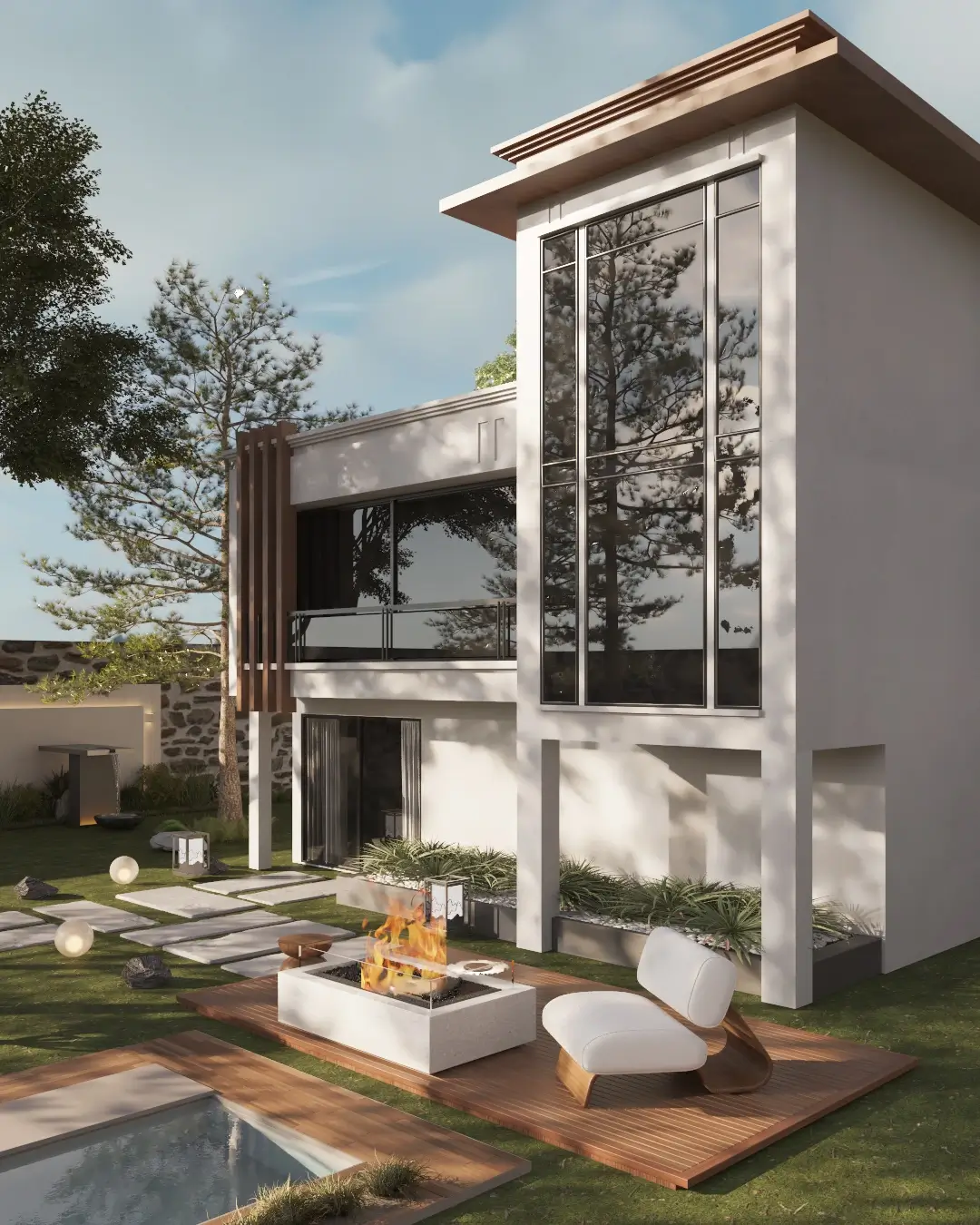
Why Exterior 3D Rendering Matters for Real Estate Companies
In a competitive property market like Luxembourg, the way a building is presented can be as decisive as the building itself. Long before the first stone is laid, buyers, investors and planning authorities form an opinion based on how convincingly a project is shown. This is where exterior 3D rendering has become an essential tool for real estate companies and property developers.
Exterior 3D visualization is the process of creating photorealistic images of a building and its surroundings—facades, materials, landscaping, light and context—before construction begins. For real estate professionals, it turns an abstract plan into something a client can see, feel and trust.
Selling Off-Plan with Confidence
In many active property markets — Luxembourg is a good example — much of the residential and commercial development is sold off-plan, before completion. Asking a buyer to commit to a property that does not yet physically exist requires a powerful, believable preview.
A photorealistic exterior render shows the future facade in its real environment: the proportions of the building, the quality of the materials, the relationship with the street and the surrounding green spaces. It removes uncertainty and helps prospects make a decision earlier and with greater confidence.
Faster, Stronger Marketing
For an estate agency or developer, exterior renderings are marketing assets that work everywhere—brochures, property portals, social media, hoardings on the construction site and investor presentations.
- Listings stand out — a striking exterior image attracts more attention than a technical plan.
- Consistent brand image — renders can be styled to match the positioning of a premium development.
- Reusable across channels — one set of visuals serves print, web and presentations.
A high-quality exterior render is not decoration—it is a sales tool that shortens the distance between a project and a signed contract.
Supporting Planning and Stakeholder Approval
Exterior visualization is not only about selling. It also helps developers communicate with architects, municipalities and investors. Showing how a building integrates into an existing neighborhood—its height, massing, materials and landscaping—makes discussions with stakeholders clearer and faster.
In markets such as Luxembourg, where developments often sit within dense or heritage-sensitive contexts, the ability to demonstrate how a project respects its surroundings is a real advantage during approval and consultation phases.
Testing the Design Before Building It
Materials, colors and facade compositions behave differently in reality than on a sample board. Exterior 3D rendering allows a developer to compare options—a mineral facade versus a warmer material palette, different window rhythms, landscaping variations—before any costly decision is made on site.
This reduces expensive late changes and ensures the finished building matches the promise made to buyers.
What Makes a Strong Exterior Render
The value of a render depends on its realism and accuracy. A reliable exterior visualization is built on solid information:
- Architectural plans and elevations with accurate dimensions.
- Material and finish specifications for the facade.
- The real site context, orientation and surrounding buildings.
- Landscaping intentions and the desired atmosphere.
- The target audience—premium buyers, investors or institutional clients.
With this input, the rendering becomes a faithful preview rather than an idealized illustration—something a real estate company can stand behind.
Recent Projects
Among our recent work: photorealistic exterior 3D renderings, including Pissange, a group of single-family homes, and Neudorf, a brick apartment building in Luxembourg City, as well as The Element, a contemporary residence in Mont-Saint-Martin, France. On these projects, our role is 3D visualization: the architecture is not designed by INTERIO. See every view in our exterior portfolio.

Frequently Asked Questions
What is exterior 3D rendering?
Exterior 3D rendering is the creation of photorealistic images of a building and its surroundings—facades, materials, landscaping and light—before construction begins, giving real estate buyers and developers a believable preview of the finished property.
How does exterior 3D rendering help sell off-plan?
It replaces abstract plans with a convincing visual of the future building in its real context. This reduces buyer uncertainty and helps prospects commit earlier—particularly valuable in markets where much is sold off-plan, such as Luxembourg.
What do you need to create an accurate exterior render?
Architectural plans and elevations with accurate dimensions, facade material and finish specifications, the real site context and orientation, landscaping intentions and a clear idea of the target audience.
Is exterior 3D rendering only for large developments?
No. It benefits projects of every scale—from a single house to large residential or commercial developments—wherever presentation influences a buyer, investor or planning decision.
Conclusion
For real estate companies and property developers — including those active in competitive markets like Luxembourg — exterior 3D rendering is no longer optional. It accelerates off-plan sales, strengthens marketing, supports planning approval and protects design decisions. In any market where presentation drives perception, photorealistic exterior visualization is one of the most effective investments a developer can make.
At INTERIO Studio, we create photorealistic exterior visualizations for residential and commercial real estate projects, helping developers present their buildings with clarity and impact.